
Marine Fuel Contamination: Causes, Risks and Prevention
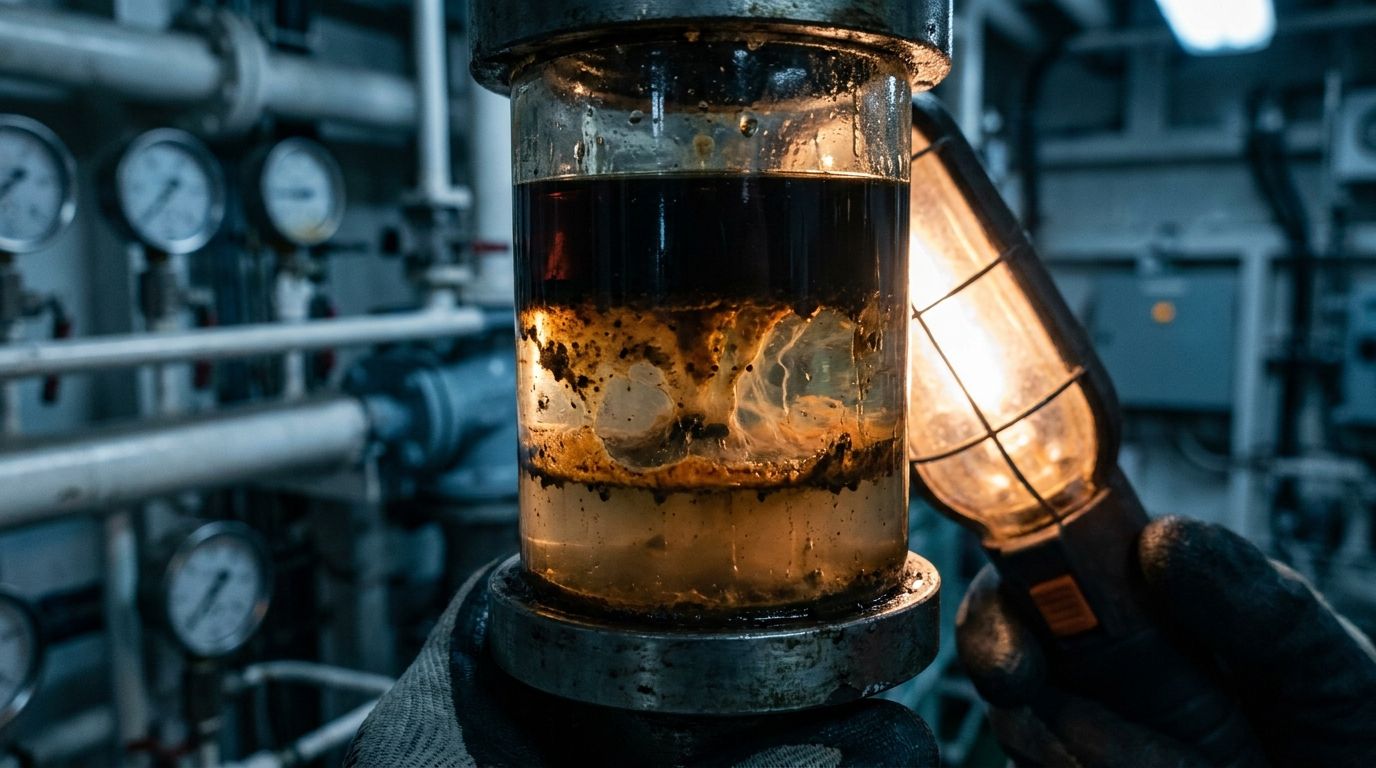
Marine diesel and gas oil rarely fail because the fuel was contaminated when it came aboard. It fails because of what happens to it afterwards - sitting in a tank, drawing in water, and quietly growing a microbial colony that blocks filters and corrodes steel. By the time the symptoms show, you are usually dealing with them at the worst possible moment: under load, at sea, and far from a workshop.
This article explains how marine fuel contamination takes hold, what it costs you, and why the answer is a compliant biocide - not just better housekeeping. It is part of our complete guide to fuel biocides and EU regulation - Read here.
What "marine fuel contamination" actually means
When operators talk about contaminated marine fuel, they usually mean one of two linked problems: water and the microbial growth that water enables.
Water gets into marine fuel through condensation as tanks breathe with temperature changes, through tank-top leaks, and, most commonly, through bunkering. Fuel bunkered from barges is especially prone to picking up water. It only takes a little: less than a quarter-inch of water at the tank bottom is more than enough to support microbial growth.
That water is where the trouble starts.
How "diesel bug" forms in a fuel tank
"Diesel bug" is the common name for microbial infestation of fuel - bacteria, yeasts and fungi that live at the interface between water and fuel inside the tank. They need four things, and a marine fuel tank tends to supply all of them: stagnant fuel, a warm environment, water to live in, and food, which, in this case, is the diesel itself.
The microbes settle at the fuel-water interface, feed on the fuel, multiply, and form biofilms and sludge. Long stagnant periods and tropical temperatures accelerate the process dramatically.
Why modern marine fuel makes it worse: FAME and water
The shift toward biodiesel blends has made contamination more common, not less. Biodiesel (FAME) is far more readily degraded by microorganisms than mineral diesel, so fuels containing FAME spoil faster and more extensively. Worse, water content in diesel has been shown to rise as FAME concentration rises, so the very blends that feed microbes also give them more of the water they need.
What contamination costs you at sea
Heavy microbial growth is not cosmetic. When a contaminated tank is disturbed, typically during filling or in heavy weather, the consequences cascade:
- Filter clogging and fuel-line blockage. Slimy sludge rapidly blocks filters, starving engines and generators of fuel, often suddenly, and under load.
- Injector fouling and engine damage. Disturbed sludge reaches injectors and can foul or damage them.
- Corrosion. Microbes generate acidic by-products that corrode tanks, pipework and injection systems. Seawater ingress compounds this and sodium and chlorides drive corrosion throughout the fuel system.
- Operational failure. Microbial contamination has caused power-generator failures on offshore platforms, resulting in production delays, a stark reminder that this is a reliability and safety issue, not just a maintenance line item.
Why housekeeping alone is not enough
Good practice helps: monitor water content in every tank, drain free water routinely, and keep tanks clean. Controlling water is the single most effective preventive step - no free water, no growth.
But once a colony is established, housekeeping and fuel polishing reduce the conditions microbes need without killing the population that is already there. To eliminate an active colony you need a biocide, a product toxic to the microorganisms that can partition into any free water present and stop growth and proliferation. This is why marine guidance treats biocide dosing, applied at the fuel manifold, with periodic testing for fuel-degrading microbes, as standard practice for fuel destined for vessel consumption.
The compliance angle: not all biocides are a safe bet
Here is the part many operators miss. Even as biocides remain essential, the rules on which biocide actives are permitted are tightening. Under the EU Biocidal Products Regulation (EU) 528/2012, actives classified as carcinogenic (category 1A/1B) are not approved under Article 5. For a vessel operator, that creates a double risk: a microbial problem if you stop treating, and a compliance problem if your current treatment is built on an active heading for restriction.
The way through is a biocide formulated without the restricted carcinogenic actives, effective today and future-proofed against the regulatory direction of travel.
What to do next
If your vessels store or bunker diesel, especially FAME-blended diesel that sits between voyages, the practical priorities are:
- Test before you assume. A fuel sample tells you whether you already have an active colony.
- Control water at every tank. Routine draining and monitoring removes the habitat microbes depend on.
- Treat with a compliant biocide. Use a high-dose treatment to knock down an established colony, then maintain with an active that will not fall foul of tightening EU rules.
Fuelcare's FuelClear™ M15 is formulated without the restricted carcinogenic actives, and our distribution hub in Venlo (NL) means compliant product ships across Europe in days, not weeks.
See what a fuel test would reveal for your tanks - speak to the Fuelcare team, call +44 (0)1743 360784 or email sales@fuelcare.com.
Frequently asked questions
Is fuel polishing enough to stop diesel bug on a vessel?
No. Polishing and water control reduce the conditions microbes need, but they do not kill an established colony. A biocide is required to eliminate an active microbial population.
Where does the water in marine fuel come from?
Mainly condensation as tanks breathe with temperature change, tank leaks, and bunkering. Fuel bunkered from barges is especially prone to water contamination.
Does biodiesel (FAME) make contamination worse?
Yes. FAME is more readily degraded by microbes, and water content tends to rise with FAME concentration so blended fuels spoil faster and hold more of the water microbes need.
Are all fuel biocides compliant under EU rules?
No. Actives classified as carcinogenic are not approved under Article 5 of the EU Biocidal Products Regulation. Confirm your treatment's actives against the latest ECHA / Commission decisions.
Sources and further reading
CIMAC (International Council on Combustion Engines) - Guideline:Marine fuels containing FAME
ASTM D6469 - Standard guide for microbial contamination in fuels and fuel systems
Marine Safety Forum - Delivering bulk marine gas oil to offshore installations
Biocidal Products Regulation (EU) 528/2012, Article 5