
Fuel Testing
Expert fuel sampling and laboratory testing to assess fuel condition, identify contamination, and support corrective action
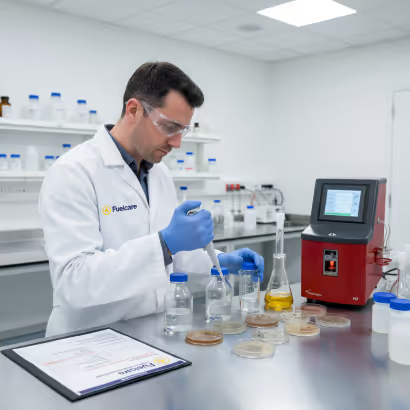
Fuelcare's testing services follow recognised ISO, IP, ASTM, and Energy Institute methodologies, with sampling support from tank bottom to delivery line across a wide range of fuel systems.
All samples are analysed by accredited laboratories, providing detailed, accurate reports on key parameters including water content, microbial activity, particulate levels, and fuel degradation.
Why Fuel Testing Matters
Untested fuel degrades in storage - accumulating water, microbial contamination and particulate matter that damage injection systems, block filters and cause unplanned downtime.
Fuelcare has delivered accredited fuel sampling and testing services since 1989, using the latest field equipment and modern laboratory facilities to analyse fuels, filters and injectors across all industries and fuel types.
The Issue
Fuel condition deteriorates during storage. Without regular testing, contamination goes undetected until it causes equipment failure or regulatory non-compliance.
Our Solution
Laboratory reports benchmarked against recognised industry limits, with clear corrective action recommendations to restore and maintain fuel specification.
Fuel Testing Process
Laboratory analysis using ASTM, IP and ISO methodologies covering microbial contamination, particulate matter, water content, chemical composition and degradation indicators - across diesel, gas oil, kerosene, biodiesel blends, aviation fuel and specialty fuels.
Contact us for specific turnaround times.
Sample
Collection
Fuel samples collected on-site using Fuelcare test kits - from tank bottom, mid-level or delivery line depending on the sampling protocol required.
Sample Submission
100–500ml samples sealed in approved containers and dispatched via dangerous goods-approved courier, with fuel MSDS documentation included.
Laboratory Analysis
Samples received, logged and analysed by certified technicians using accredited ASTM, IP and ISO methodologies - covering all critical fuel quality parameters.
Results & Recommendations
Detailed report issued with test results, technical assessment and recommended treatment or corrective actions where required.
What We Test For
Comprehensive analysis covers all critical fuel quality indicators
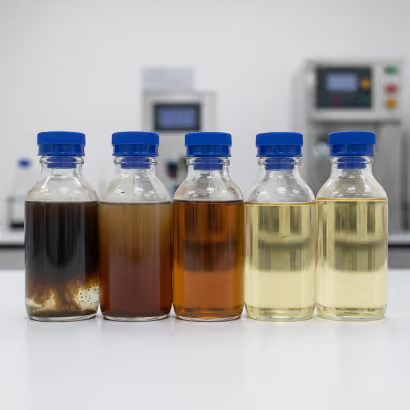
Initial assessment of fuel colour, clarity, and visible contamination. Identifies discolouration, haziness, or particulate matter that indicates degradation or microbial activity requiring further investigation.
Quantifies total viable bacteria and fungal populations. Detects sulphate-reducing bacteria that cause corrosion and tank degradation. Essential for preventative maintenance and treatment planning.
Determines free and dissolved water using Karl Fischer titration. Excess moisture promotes microbial growth and fuel instability, compromising equipment performance and fuel longevity.
ISO 4406 particle count analysis measures contamination levels across three size ranges. Ensures fuel meets equipment manufacturer specifications and operational standards for critical applications.
Advanced testing identifies fuel type, additives, and chemical stability. Detects degradation products and oxidation indicators that affect performance and shelf life across all fuel categories.
Fuelcare adheres to internationally recognised testing protocols.
ASTM D4176 (Standard Test Method for Free Water and Particulate Contamination in Distillate Fuels)
Visual assessment of fuel colour, clarity and haze factor conducted to ASTM D4176 - identifying free water, particulate contamination and visible signs of microbial activity or fuel degradation.
IP613 / IP385 (Microbial Contamination in Fuels)
Total viable bacteria count and total viable fungal count quantified to IP613 or IP385, with qualitative identification of sulphate-reducing bacteria (SRBs) - determining contamination severity and informing treatment urgency.
ISO 4406 (Cleanliness of Hydraulic Fluid Power — Particle Count)
Particle count analysis conducted across three size ranges - confirming fuel cleanliness rating and verifying compliance with equipment manufacturer specifications and operational standards.
IP387 (Filter Blocking Tendency)
Filter blocking tendency testing to IP387 identifies fuel prone to premature filter plugging due to contamination, degradation products or incompatible fuel blending - critical for high-sensitivity injection systems.
Karl Fischer Titration (Water Content Determination)
Free and dissolved water content determined by Karl Fischer titration - excess moisture accelerates microbial growth, promotes fuel instability and causes injector and tank corrosion.
Benefits of Fuel Testing
Identify issues before they compromise fuel quality and operational performance
Accurate Diagnostics
Accredited laboratory analysis of fuel samples provides precise, quantified data on contamination levels, water content, microbial activity, and particulate load - identifying exactly what is present and at what severity.
Detect Problems Early
Detect microbial growth, fuel degradation, and filter-blocking contamination early - preventing minor issues from escalating into injector failure, tank corrosion, equipment damage, or regulatory non-compliance.
Data-Driven Decisions
Verified test results give engineers and procurement teams the evidence needed to make informed decisions on fuel treatment, tank cleaning schedules, product selection, and supply chain quality management.
Which Industries and Sectors Use Fuelcare's Fuel Testing?
Rail Operators
Ensuring fuel quality to prevent engine issues and maintain operational schedules across demanding rail networks.
Aviation
Critical for flight safety and engine reliability, where fuel cleanliness is paramount for jet fuel.
Marine & Offshore
Monitoring bunker and operational fuel quality for vessels and offshore installations, reducing maintenance and ensuring regulatory compliance.
Power Generation & Data Centres
Protecting backup and primary power systems, reducing generator failure, downtime and storage-related fuel degradation.
Military & Defence
Guaranteeing operational readiness and asset longevity for essential defence equipment in challenging environments.
Heavy Industry & Mining
Protecting critical machinery and vehicle fleets from fuel-related performance issues and breakdowns.
Bulk Storage & Terminals
Maintain fuel quality throughout the storage and distribution network, preventing contamination before dispatch.
Fuelcare Fuel Testing FAQs
Find answers to frequently asked questions about Fuelcare's Fuel Testing Services.
Fuelcare's fuel testing service analyses samples in accredited laboratories for the key indicators of fuel quality and contamination. Standard parameters include: water content (free and dissolved), microbial contamination (bacteria, fungiand yeast — IP-385 and IP-472 methods), particle count and cleanliness (ISO4406), oxidation and stability markers, FAME content and quality, visual assessment (colour and clarity), and specific gravity. Additional parameters can be specified on request.
Contact Fuelcare at sales@fuelcare.com or call +44 (0)1743 360784. Fuelcare can supply self-sample test kits with full instructions for straight forward applications, or dispatch a technician to collect samples where professional on-site sampling is required. A Fuel Testing Kit can be requested here.
Standard laboratory turnaround is typically five to ten working days from sample receipt, depending on the test parameters requested. Expedited turnaround can be arranged for urgent situations - contact Fuelcare's technical team to discuss requirements.
If results indicate contamination or quality failure, Fuelcare will provide a clear written report explaining the findings and a recommended treatment protocol. Depending on the issue, this may include biocide treatment (microbial contamination), fuel polishing (particulate or water), stability treatment (oxidation or degradation), or in severe cases, fuel disposal and replacement. Fuelcare can supply all necessary treatment products and, where required, provide on-site support.
Fuelcare's laboratory testing uses recognised industry standards including: IP-385 (microbial contamination in distillate fuels), IP-472 (aerobic bacteria), ISO4406 (particle cleanliness), ASTM D6304 (water content by Karl Fischertitration), ASTM D1796 (water and sediment in fuel oils) and relevant EN590 diesel quality parameters. All testing is conducted by accredited laboratories.
Yes. Fuelcare can provide self-sample test kits with detailed instructions for clients who prefer to collect their own samples. However, for critical fuel systems or where contamination is suspected in hard-to-reach areas (tank bottoms, filter sumps, delivery points), professional on-site sampling by a Fuelcare technician is recommended to ensure sample representativeness and reliable results.