
CarbonClear™ Fuel Detergent
Decarbonise, enhance fuel quality, and optimise fuel efficiency without requiring additional equipment
Meeting emissions regulations and improving operational efficiency no longer requires fleet overhauls or alternative fuel transitions.
CarbonClear™ is a multi-functional PIBSI fuel detergent and diesel additive with over 20 years of verified results across marine, offshore and rail applications, treating in excess of 100 million litres of fuel annually. Verified performance data shows 5–10% CO2e reductions, 3–5% improvement in engine power and torque, and 3–5% fuel consumption reduction.
CarbonClear™ maintains engine cleanliness, improves fuel economy and supports decarbonisation targets without equipment modification.

Industries
Marine, Offshore, Rail & Bus
Fuels
Diesel, HVO, Gas Oils, Kerosene, Petrol, & MGO Applications
Approvals
REACH & Worldwide
Dose Rates
1000ppm for middle distilate fuels and 400ppm for marine applications

CarbonClear™ Fuel Detergent
Decarbonise, enhance fuel quality, and optimise fuel efficiency without requiring additional equipment.
Technical specifications
CarbonClear™ is recommended at a dosage of 1:1000 by volume (1000 ppm v/v), equating to 1 litre of additive per 1m³ of fuel. This dosage is effective across all middle distillate fuels, including diesel, HVO, and gas oils. For marine applications, a reduced dose rate of 400 ppm v/v (1:2500 by volume) is recommended, equating to 400ml of additive per 1m³ of fuel. CarbonClear™ is not suitable for use with residual fuels.
CarbonClear™ is delivered as an integrated system, designed for seamless incorporation into the bunkering process. Application is facilitated by a compact additive injection system, deployed either on-vessel or at a terminal. This system autonomously doses the additive at the correct ratio during fuelling, ensuring precise and safe application without requiring manual intervention.
CarbonClear™ is specifically formulated for broad compatibility with middle distillate fuels, including EN590 diesel, BS2869 gas oils, ISO8217 marine fuels, HVO, Kerosene, MGO, fuel emulsions, and biodiesel blends (up to B50). It is suitable for all diesel engine types, encompassing light-duty to heavy-duty applications, but is not designed for use with residual fuels.
CarbonClear™ effectively mitigates a broad spectrum of harmful emissions, specifically targeting CO2, NOx, SOx, particulate matter (PM), and hydrocarbons (HC). This enables operators to achieve stringent environmental compliance and decarbonisation objectives, with verified 5-10% CO2e reductions derived from improved combustion efficiency, without compromising engine performance or fuel economy.
CarbonClear™ actively maintains the cleanliness of new engines and works to decarbonise and remediate deposits in older engines. It effectively removes fuel system deposits, optimises combustion efficiency, minimises the risk of premature wear to fuel pumps and injection equipment, and safeguards fuel systems against contaminants, wear, fouling, and corrosion. This results in increased power delivery and reduced fuel consumption.
CarbonClear™ meets all relevant REACH registration requirements and adheres to global emission standards. Its formulation is engineered to support critical fuel quality standards, including EN590 and ISO8217 specifications.
CarbonClear™ is a stable formulation demonstrating excellent shelf life. It requires storage in a dry, cool, and well-ventilated environment, protected from direct sunlight and incompatible materials. Containers must be kept tightly closed and sealed until the point of use. The product is fully compatible with standard fuel storage infrastructure and existing dispensing systems.
Operators consistently report a comprehensive range of benefits, including a verified 3-5% reduction in fuel consumption, a 3-5% increase in engine power and torque, and overall enhanced fuel economy. Additionally, CarbonClear™ contributes to smoother operational performance and extended maintenance intervals by actively maintaining cleaner engines and fuel systems. It is important to note that specific results may vary depending on the baseline engine condition and fuel quality.
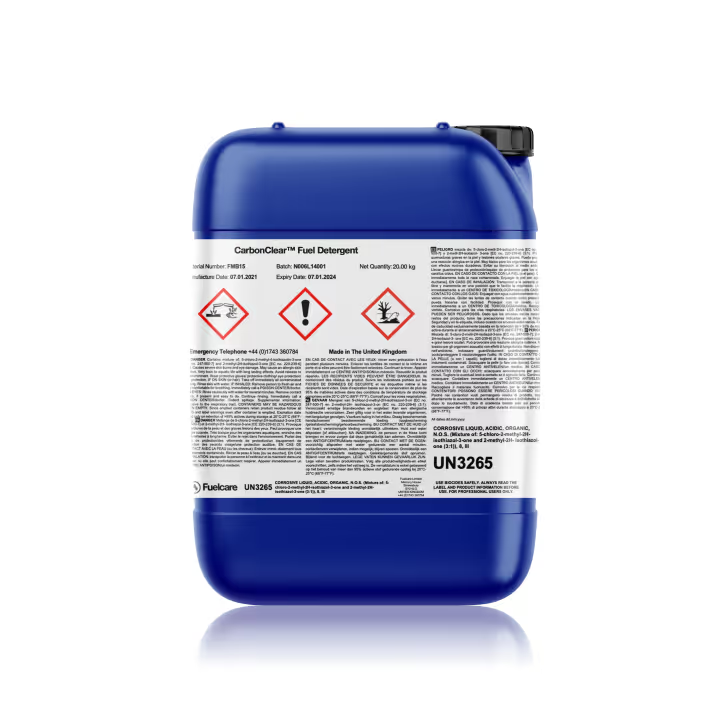
What CarbonClear™ Fuel Detergent Delivers Across Your Fuel System
CarbonClear™ is a multi-functional PIBSI diesel fuel detergent and combustion improver with over 20 years of verified field and test cell data. Compatible with EN590, BS2869, ISO8217 marine grade fuels and biodiesel blends up to B50, it is used across rail, offshore, marine and industrial applications treating in excess of 100 million litres of middle distillate fuel annually.
Measurable Emissions Reduction
CarbonClear™ has been independently verified to reduce CO2e emissions by 5–10% through improved combustion efficiency. ISO 8178 duty cycle testing on both Cummins and MTU engines demonstrates reductions in CO2, NOx, SOx, particulate matter and hydrocarbons - providing documented evidence for emissions compliance and decarbonisation reporting requirements.
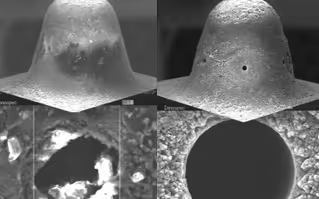
Injector Deposit Control
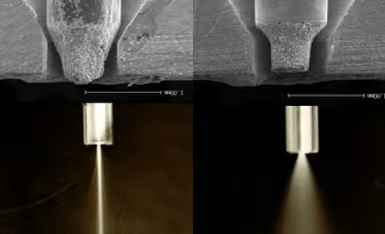
Carbonaceous deposits on injector nozzles restrict fuel atomisation, increase ignition delay and drive incomplete combustion. CarbonClear™ detergent chemistry removes existing deposits and prevents re-formation, validated to CEC F-23-01 (XUD9) and CEC F-98-08 (DW10B). In dirty-up testing, average injector flow loss in EN590 fuel was reduced from 71.3% to 1.0% with additive treatment.
Reduced Fuel Consumption
Improved combustion efficiency directly reduces the volume of fuel required to achieve the same work output. Verified across rail, marine and offshore duty cycles, CarbonClear™ delivers a 3–5% reduction in fuel consumption - a directly quantifiable reduction in operating cost that compounds across fleet scale and annual fuel volumes.
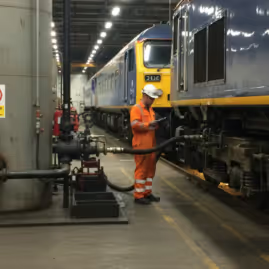
Independently Tested and OEM Approved
Performance data has been generated through hundreds of engine tests conducted by an independent third-party test facility. CarbonClear™ holds Lloyd's Register Product Verification Service approval and ClassNK approval in commercial shipping, providing the documentation required for OEM and classification society compliance programmes.

How To Order
Find the right option for your operations and location


CarbonClear™ Product FAQs
Find answers to common questions about CarbonClear™ fuel detergent performance and application.
CarbonClear™ provides a comprehensive range of benefits, including verified 5-10% reductions in CO2e emissions and 3-5% reductions in fuel consumption, alongside a 3-5% increase in engine power and torque. Its advanced detergent formulation actively cleans fuel systems, prevents deposit build-up, and optimises combustion efficiency. These benefits are achieved across all diesel engine types without requiring additional equipment or modifications to existing fuel systems.
CarbonClear™ employs a proprietary multi-functional detergent blend (PIBSI chemistry) that operates on a 'keep clean' and 'clean up' principle. When mixed with fuel, it actively removes existing fuel system and engine deposits while preventing new ones from forming. This action significantly improves combustion efficiency, maintains engine cleanliness, decarbonises older engines, and protects critical components. The result is enhanced power delivery, reduced fuel consumption, and lower emissions throughout the engine's operational lifecycle.
The recommended dosage for CarbonClear™ is 400 ppm (parts per million by volume), which precisely equates to 400ml of additive per 1m³ (1,000 litres) of fuel. This maintains a consistent treatment ratio of 1:2,500.
CarbonClear™ is formulated for broad compatibility with all diesel engine types, ranging from light-duty to heavy-duty applications. It is effective across a wide array of middle distillate fuels, including EN590 diesel, BS2869 gas oils, ISO8217 marine fuels, HVO, kerosene, MGO, fuel emulsions, and biodiesel blends (up to B50). Its application is widespread across sectors such as marine, offshore, rail networks, and European forecourts.
CarbonClear™ is supplied as an integrated system featuring an automated injection unit. This unit comprises a diaphragm pump, an additive tank, and associated control electronics. Installation is straightforward, typically connecting to onboard power (110V or 240V), an existing onboard flow meter, and an injection point, with installation often completed within 6 hours. During bunkering, the system's flow meter-driven mechanism ensures the precise, automatic dosing of the additive into the fuel stream. Fuelcare leverages over 20 years of expertise in additive dosing technology, with numerous successful installations on commercial vessels, superyachts, and shore-based facilities.
Yes, CarbonClear™ is formulated to be fully compatible with all standard fuel system materials, including seals, hoses, and filters. Extensive testing and real-world application have demonstrated no adverse effects on fuel system components, engine materials, or lubricants. Its ashless composition also ensures it does not contribute to particulates or emission loading.
No. When used at the recommended dose rate, CarbonClear™ has no measurable impact on standard fuel specifications. Its unique formulation ensures that treated fuel continues to meet all relevant international and national standards, including those for middle distillate fuels.
CarbonClear™ meets all relevant REACH registration requirements and is compliant with global emission standards. Its detergent benefits have been verified by Lloyd's Register Product Verification Service. Additionally, it holds ClassNK approval for commercial shipping applications, providing robust third-party validation of its performance and suitability.
Biodiesel blends (F.A.M.E.) can introduce several challenges, including increased water absorption, microbial growth potential, and deposit formation. CarbonClear™'s formulation helps mitigate these issues by improving fuel stability, enhancing water separation, and preventing the build-up of deposits associated with biodiesel content, thereby safeguarding fuel quality and system integrity.
Yes, CarbonClear™ significantly improves key fuel chemistry parameters. It enhances lubricity (to ISO12156), oxidation stability (to ISO12205), and thermal stability (to ASTM D6468). These improvements contribute to reducing wear on fuel system components, preventing fuel degradation during storage, and maintaining consistent fuel quality under varying operational conditions.