
FAME Diesel Water Contamination: Why Biodiesel Spoils Faster
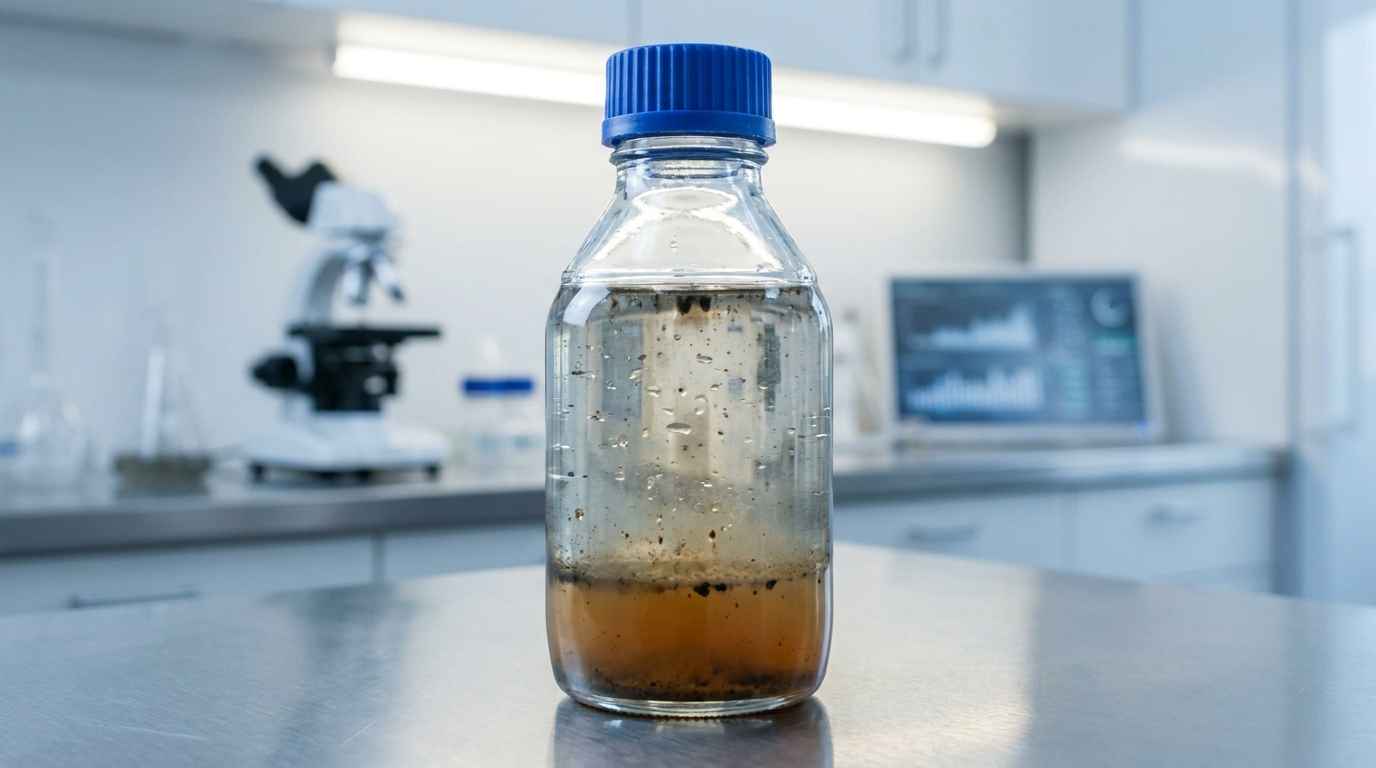
The shift to biodiesel blends has changed the contamination risk profile of stored diesel in ways that many operators have not fully accounted for. Fatty Acid Methyl Esters - FAME, the biodiesel component blended into EN590 automotive diesel at up to 7% (B7) and now present in many marine and industrial fuels - attract and hold water more readily than mineral diesel, degrade faster in the presence of microorganisms, and create conditions that allow microbial colonies to establish more quickly and extensively than was historically expected.
This is not a theoretical problem. Field surveys and laboratory studies consistently show that fuels containing FAME are more susceptible to microbial contamination, and that the risk rises with FAME concentration. This article explains the mechanism, what it means in practice for stored-fuel management, and why the standard guidance developed for mineral diesel may no longer be adequate. It is part of our complete guide to fuel biocides and EU regulation - Read here.
What FAME is and why it is now in almost every diesel tank
FAME (Fatty Acid Methyl Esters)- is produced by transesterification of vegetable oils or animal fats. Blended into automotive diesel in quantities up to 7% under EN590 (B7), it is now the standard diesel specification across the EU and UK for road transport. It has spread into many marine and off-road fuel supplies too, carried in the distribution chain even when it is not a specified requirement.
The blend rationale is sound: FAME reduces net carbon emissions, improves lubricity and is renewable. The storage problem is that FAME has a fundamentally different chemistry to mineral diesel in two ways that matter operationally: it is hygroscopic and it is more readily biodegraded by microorganisms.
Why FAME attracts and holds more water than mineral diesel
Mineral diesel is largely non-polar and resists water absorption. FAME contains ester bonds, a polar functional group, that have an affinity for water molecules. This hygroscopic property means FAME absorbs moisture from the atmosphere, from condensation on tank walls, and from any free water present in the tank bottom, distributing that water throughout the fuel rather than allowing it to settle cleanly.
The practical consequence is measurable. Laboratory studies demonstrate a clear correlation between FAME concentration and water content: the higher the FAME percentage, the higher the total water detected in the fuel, in both dissolved and free forms. This matters because EN590 allows a maximum of 200 mg/kg water content, a limit that modern FAME-blended fuels can approach or breach without the contamination being obvious. Independent analysis confirms that FAME can hold up to 1,500 ppm dissolved water, far beyond the 200 mg/kg EN590 limit, making the standard specification much harder to maintain consistently in stored FAME-blended fuel.
The direct link between FAME, water and microbial growth
Water is the enabling condition for microbial growth in fuel so no free water, no meaningful colonisation. The corollary is that anything which increases water content or makes water control harder raises the contamination risk. FAME does both.
The evidence is direct: a global survey of marine distillate fuel samples found that 45% of FAME-positive samples contained some level of microbial contamination, and analysis revealed a strong correlation between FAME content, water content and viable microbe count. FAME-free samples were notably less susceptible.
Laboratory microcosm studies reinforce this directly: fuels with 2% FAME or more showed significantly more microbial growth and faster growth than FAME-free diesel. As FAME concentration increased from B0 through B10 to B20, both total biomass and the rate at which contamination established increased. The Energy Institute's research programme on this relationship reached the same conclusion.
Why FAME is more readily degraded by microorganisms
Beyond the water issue, FAME is intrinsically more biodegradable than mineral diesel. The ester bonds that make it hygroscopic also make it metabolically accessible. Microorganisms can break down the fatty acid chains more efficiently than the longer hydrocarbon chains of mineral diesel. The result is that microbes do not merely use FAME as a minor supplement to mineral diesel nutrition; they preferentially degrade it.
One practical consequence is that as FAME concentration in a blend increases, there is also a shift in the microbial community: bacterial-dominated early growth transitions towards fungal-dominated contamination at higher FAME levels. Fungi produce tough, adherent mycelial mats at the fuel-water interface that are physically harder to remove by fuel polishing alone. This compounds the contamination challenge at higher FAME concentrations.
Why existing water-control procedures may not be enough
The standard operational guidance for water management in stored fuel was largely developed for mineral diesel, and it may not translate adequately to FAME blends. Two specific areas are affected.
Settling time
When fuel is received into a tank, industry guidance typically calls for a settling time of approximately three hours per metre of product height before drawing from the tank, to allow water and microorganisms to separate and settle. Studies show this settling time is likely adequate for B10, but probably inadequate for B20 - FAME blends hold water in suspension more stubbornly, extending the time needed for clean separation. In practice, many operators do not adjust their settling procedures for the FAME content of the fuel they are receiving.
Water monitoring limits
The EN590 maximum of 200 mg/kg water is a specification limit, not a contamination-free threshold. At concentrations well below this limit, if water is distributed through the fuel as FAME holds it rather than settled at the bottom, there is still sufficient free water available at the tank bottom to support microbial growth. Monitoring based only on periodic water checks may miss the risk.
FAME, oxidation and the accelerated degradation cycle
Water alone does not fully explain why FAME-blended fuels spoil faster in storage. Oxidative degradation adds a second mechanism. FAME contains unsaturated fatty acid chains that are more susceptible to auto-oxidation than mineral diesel hydrocarbon chains. In the presence of oxygen and heat, these chains form free radicals that polymerise into higher-molecular-weight compounds, insoluble gums and sediments that contribute to filter plugging independently of microbial activity.
Water accelerates this: hydrolytic oxidation of unsaturated FAME components in the presence of water produces smaller organic acids and alcohols, raising the fuel's Total Acid Number (TAN) and making it progressively more acidic which in turn accelerates tank corrosion and creates a more nutrient-rich environment for further microbial growth. The degradation pathways reinforce each other.
What this means for biocide strategy
The combination of higher water content and more readily degradable fuel means that FAME-blended diesel requires more active fuel management than mineral diesel, particularly for fuel held in long-term storage, used intermittently, or carried in tanks with limited turnover. Vessels on seasonal routes, standby generators, emergency reserves and bunkered fuel sitting between voyages are all higher-risk scenarios.
The biocide response needs to account for this. A preventative dose (150 ppm) added at the time of each fuel receipt is the standard approach for managed fuel systems. Where FAME content is high or turnover is low, more frequent testing and the readiness to escalate to a curative dose (300 ppm) are warranted. The biocide chosen should be one that is effective in FAME blends and not all formulations are.
Fuelcare's FuelClear™ M15, based on C(M)IT/MIT, is confirmed effective in biodiesel blends including B100, achieving 99.9% kill or better at standard treat rates. It is also BPR PT6-approved and formulated without the carcinogenic actives now under restriction, ensuring compliance as EU rules tighten.
What to do next
If your tanks currently hold or regularly receive FAME-blended diesel, the practical priorities are:
- Know your FAME content. Confirm the FAME percentage in your current fuel supply and adjust your water monitoring and settling procedures accordingly.
- Increase testing frequency. FAME blends approach the EN590 water limit more easily so periodic dip testing or continuous water monitoring is more important than with mineral diesel.
- Treat preventatively, not reactively. A biocide added at receipt is far cheaper than a curative programme after contamination is established.
- Confirm your biocide works in FAME blends. Not all products are effective at FAME concentrations that are now standard in stored fuel.
See what a fuel test would reveal for your tanks - speak to the Fuelcare team, call +44 (0)1743 360784 or email sales@fuelcare.com.
Frequently asked questions
Why does FAME biodiesel cause more microbial contamination than mineral diesel?
Two reasons: FAME is hygroscopic. It attracts and holds more water than mineral diesel, providing more of the key resource microbes need and FAME is more readily biodegraded, so it is a better nutrient source for the bacteria and fungi involved. Together, these make FAME-blended fuels significantly more susceptible.
What is the maximum water content allowed in EN590 diesel?
EN590 specifies a maximum of 200 mg/kg water content. FAME can hold substantially more dissolved water than this before becoming visibly hazy, meaning fuel that looks clean may be carrying enough moisture to support microbial growth at the tank bottom.
Does all road diesel now contain FAME?
Standard EN590 automotive diesel in the EU and UK allows up to 7% FAME (B7) and this is the normal commercial specification. Marine gas oil and heating oil supplies also increasingly contain FAME components, either by specification or carried in distribution. Operators should confirm the FAME content of their specific supply.
Does the settling time after fuel delivery change with FAME content?
Yes. Standard guidance of approximately three hours per metre of tank height is probably adequate for B10 fuels, but may be inadequate for B20 - FAME suspends water more persistently, requiring longer for full separation and settlement. This matters for both water control and for minimising disturbance of any settled biomass.
Sources and further reading
CIMAC (International Council on Combustion Engines) - Guideline:Marine fuels containing FAME
Energy Institute - Guidelines on water content in biodiesels andmicrobial growth
DNV - Using biodiesel in marine diesel engines: new fuels, new challenges
BSI - BS EN 590 Automotive fuels. Diesel. Requirements and test methods
Irish EPA - The increased risk of corrosion with the use of FAME