
Marine Fuel Testing: Methods, Test Kits and How Often to Test
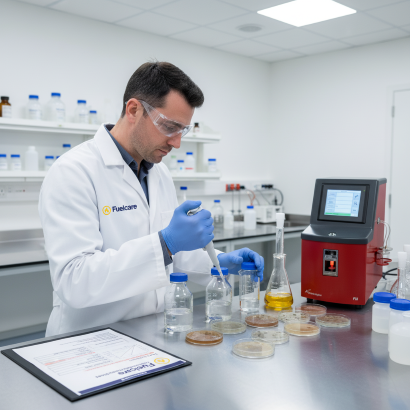
You cannot manage what you have not measured. Microbial contamination in marine fuel develops silently at the bottom of the tank, invisible until a filter blocks or an engine loses power under load. Fuel testing is how you find the problem while it is still cheap to fix and, just as importantly, how you confirm a treatment has worked. This article explains the ways Fuelcare can test your marine diesel, when to use each, how often to test, and how testing fits into a compliant treatment programme. It is part of our complete guide to fuel biocides and EU regulation - Read here.
Why test marine fuel at all?
Stored and bunkered marine diesel sits still for weeks or months, draws in water through condensation and bunkering, and provides a food source for bacteria, yeasts and fungi. By the time contamination is visible (dark sludge on a filter, a hazy sample, a sulphurous smell), a colony is already well established. Testing gives you three things that guesswork cannot:
- Early warning. A routine test detects rising microbial contamination before it becomes an operational failure, so you can treat preventatively rather than react to a breakdown.
- Evidence before treatment. Testing confirms whether you actually have an active colony, and how heavy it is which determines whether you need a preventative, curative or shock biocide dose.
- Proof after treatment. A follow-up test confirms the treatment worked and gives you a documented baseline for your fuel-management records.
The three ways Fuelcare tests marine fuel
Fuelcare offers three routes to check marine fuel for microbial contamination, from a quick on-board self-test to full accredited laboratory analysis. Most operators use a combination: dip slide self-tests for routine monitoring, and laboratory analysis when a problem is suspected or a self-test comes back high.
1. FuelClear™ M68 self-test dip slides
The FuelClear™ M68 Fuel Test Kit is an economical and accurate self-test for detecting the common microbial contaminants in hydrocarbon fuels - the bacteria, yeasts and moulds behind the diesel bug. Each kit contains test tubes with paddles coated in an agar culture medium, plus disposable gloves, and is supplied in boxes of 2 or 10 tests.
The test is simple: dip the slide into a fuel sample, incubate it in the supplied tube for 48 hours, then read the result against the chart provided with the pack. One side of the paddle shows bacteria, the other shows yeasts and moulds, so you can see at a glance what type of contamination is present and how heavy it is.
Dip slides are designed for continual monitoring. They are the right tool where there is an ongoing fuel-checking procedure and a known risk of microbial contamination, such as vessels storing fuel for long periods or tanks with a history of water accumulation.
2. Laboratory sample kits
For a more detailed picture, Fuelcare can supply a sample kit with full instructions, so you can take your own fuel sample and send it to Fuelcare's laboratory for accredited analysis. Samples of 100-500 ml are sealed in an approved container and dispatched via a dangerous-goods-approved courier, with the fuel's MSDS included. Standard laboratory turnaround is typically five to ten working days from sample receipt, and expedited turnaround can be arranged for urgent situations.
3. Engineer site sampling and full laboratory analysis
Where fuel is business-critical, contamination is suspected, or sample points are hard to reach, a Fuelcare engineer can visit your site or vessel, collect the samples professionally and take them back to the laboratory for detailed analysis. Sampling follows ISO 3170 and ASTM D4057, the recognised standards for representative manual sampling of petroleum products, and covers tank bottoms and sumps, mid-tank levels, delivery and dispensing points, fuel filter debris, and biofilm or sludge deposits.
Fuelcare's accredited laboratory analysis covers the critical indicators of fuel condition:
- Microbial contamination - total viable bacteria and fungal counts to IP-385 and IP-472, with identification of sulphate-reducing bacteria (SRBs), the organisms behind tank corrosion
- Water content - free and dissolved water by Karl Fischer titration (ASTM D6304)
- Fuel cleanliness - ISO 4406 particle count across three size ranges, checked against equipment manufacturer specifications
- Visual assessment - colour, clarity and haze to ASTM D4176
- Filter blocking tendency - IP387 testing to identify fuel prone to premature filter plugging
- Fuel quality parameters - degradation and stability markers, FAME content and relevant EN590 diesel parameters
Filters and injectors can be analysed alongside fuel samples - so a filter that has clogged prematurely, or is coated in a dark slimy residue, can be sent in for confirmation of microbial contamination.
How to take a representative sample
A test is only as good as the sample. Whether you are using a dip slide or filling a laboratory sample container, these points apply:
- Sample from the tank bottom. Microbes live at the fuel-water interface, so a bottom or drain sample is far more informative than a mid-tank sample. This is why Fuelcare's own sampling service focuses on tank bottoms, sumps and delivery-line points.
- Use clean equipment. Contaminated samplers or containers give false positives. Sampling gear should be clean and dry before use.
- Take a decent volume for laboratory work. If you are sending a sample to Fuelcare's laboratory, submit 100-500 ml in a sealed, approved container via a dangerous-goods-approved courier, with the fuel's MSDS included. Contact Fuelcare if you are unsure of the requirements.
- Test promptly. Once a sample is taken, any microbes present begin to die off. Dip a self-test slide soon after drawing the sample, and dispatch laboratory samples without delay.
How often should marine fuel be tested?
Testing frequency depends on how long fuel is stored, how much water the tank tends to hold, and the fuel's history. As a general guide:
- Routine monitoring: use FuelClear™ M68 dip slides as part of an ongoing fuel-checking procedure, with tank-bottom or drain samples taken regularly. Higher-risk tanks (long storage periods, warm conditions, high FAME content, past contamination) warrant more frequent checks.
- Professional sampling: Fuelcare recommends a minimum of one professional site sampling visit per year for most fuel systems, and quarterly sampling for critical marine and offshore operations.
- Before a voyage or period of demand: test fuel that has been sitting, before you rely on it. Finding a problem in port is far cheaper than finding it at sea.
- After treatment: retest to confirm the biocide worked and the colony has been knocked down.
From test result to treatment decision
The value of a test is the decision it drives. A typical decision path:
- Acceptable result: continue routine monitoring, drain any free water found, and maintain a preventative biocide dose (around 150 ppm) on subsequent fills.
- Moderate contamination: apply a curative dose (around 300 ppm), observe the minimum contact time, then filter or polish to remove dead biomass, and retest.
- Heavy contamination: confirm with a laboratory sample, consider tank cleaning if sludge is present, apply a shock dose (around 1,000 ppm), be ready for extra filter changes, and retest. Note that biocide treatment can initially increase suspended particulates as the biomass is killed off, so additional filtration is often needed.
Whichever route applies, the biocide you reach for should be BPR PT6-approved and built on an active that is not classified carcinogenic - so the treatment does not create a compliance problem while solving a contamination one. Fuelcare's FuelClear™ M15, based on non-carcinogenic C(M)IT/MIT, is formulated for exactly this.
What to do next
If your vessels store or bunker diesel and you are not currently testing on a defined schedule, start with a box of FuelClear™ M68 dip slides for routine on-board monitoring. If a slide flags contamination, confirm it with a Fuelcare laboratory sample and treat with a compliant biocide before the next period of demand.
Want help setting up a fuel-testing routine, or a compliant biocide to treat what you find? Speak to the Fuelcare team - call +44 (0)1743 360784 or email sales@fuelcare.com.
Frequently asked questions
What is the best way to test marine diesel for diesel bug?
For routine on-board monitoring, a FuelClear™ M68 dip slide gives a reliable reading in 48 hours: dip the slide in a fuel sample, incubate it in the supplied tube, and compare the growth against the chart provided. For a confirmed, detailed result, send a tank-bottom sample to Fuelcare's accredited laboratory or arrange an engineer sampling visit. Many operators use dip slides routinely and laboratory analysis to confirm a suspected problem.
How often should I test stored marine fuel?
Use dip slides as part of an ongoing fuel-checking procedure, take tank-bottom or drain samples regularly, more often for higher-risk tanks with warm conditions, high FAME content, long storage or a history of contamination and book professional site sampling at least annually, or quarterly for critical operations. Always test fuel that has been sitting before you rely on it, and retest after any biocide treatment to confirm it worked.
Where should I take the fuel sample from?
From the tank bottom or a drain point, because microbes live at the fuel-water interface where water settles. Use clean, dry sampling equipment to avoid false positives, and test the sample promptly - microbes start to die off once the sample is drawn.
Can I test fuel that has already been treated with biocide?
Yes. Retesting after treatment is exactly how you confirm a biocide dose has worked. Fuelcare recommends a follow-up test after any curative treatment - either a dip slide or a laboratory sample - so you have a documented before-and-after record for your fuel-management programme.
Sources and further reading
- FuelClear™ M68 Fuel Test Kit - product data sheet (Fuelcare)
- Fuelcare - Fuel testing and laboratory analysis
- Fuelcare - Site fuel sampling to ISO 3170 and ASTM D4057
- ISO 3170:2025 - Hydrocarbon liquids, manual sampling
- Biocidal Products Regulation (EU) 528/2012, Article 5 - exclusion criteria